Ecuador Travels

 I went to Ecuador one summer in my 20s. I didn't keep a travel journal and only took pictures of one of the regions we visited (gasp!)  Here they are:


Scenes from the weekly market in Otavalo, Ecuador:


The people of Ecuador's Otavalo region wear distinctive traditional attire and headwear of blue and black:


Otavalo's weekly cattle market---fantastically chaotic:


The women of Otavalo are so elegant in their fantastic jewelry and traditional attire:


More chaotic scenes at Otavalo's cattle market:


Otavalo portrait:


While in the Otavalo area, Dani and I took a fantastic tour of the villages conducted by a local gentleman, and the residents were so gracious in demonstrating their traditional crafts.


Travels in Peru

Didn't do much journal writing while traveling in Peru, so I pretty much only have the photos to share. Somewhere along the line, I did turn them into these little collages though. :)
--


Scenes from Cusco, the old capital of the Incan Empire.  What an amazing place! 
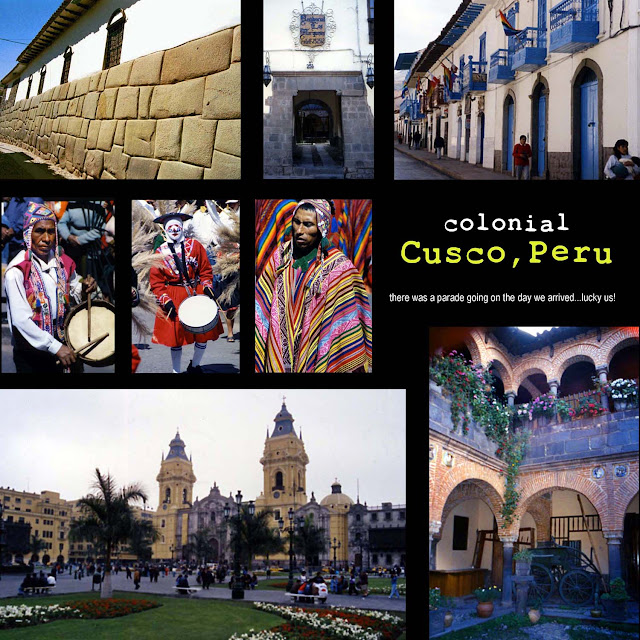


With our base in Cusco, we visited many other sites and small communities that are remnants of the great Incan Empire -- like Ollyantambo and Saqsayhuaman, and of course Machu Picchu.  Here's some pictures from those stops:


(You'd think I would have taken more pictures of Machu Picchu.  Sheesh!

As usual, I loved the human component, and you can't beat a rural market for loads of culture!


One memorable stop was staying on little Taquile Island, on Lake Titicaca. We did a 2 day homestay and while it wasn't exactly comfortable (no electricity, rodents, etc...), it was very fascinating!


We also visited the Uros Islands,  which are really quite amazing. They entirely manmade out of reeds, and were originally made by small groups seeking to flee the conquering Incan empire. Sadly, today it's really little more than a tourist attraction, with locals continuing to inhabit the islands just to sell tourist garb. But still...pretty cool to see an island made out of reeds!!!


We also spent a few days in Arequipa, a beautiful coastal city in the south of the country. One of my favorite sites in the city is the historic Santa Catalina Monastery, home to hundreds of nuns in it's heyday, but is now quiet and more populated by visiting tourists than resident nuns.


And I vividly remember visiting Colca Canyon! Our bus broke down three times, and this was especially unpleasant for me because I had very bad altitude sickness since arriving in South America, and on this ride I was having a really hard time breathing with the thin air of the high Andean passes. It was scary. I admit it -- I cried.  Breathing is kind of important.

Here are some scenes en route to Peru's Colca Canyon, reputed to be the deepest canyon in the world. (Top right): One highlight was watching the condors ride the thermals up the canyon early in the morning. (Middle right):  (Bottom right): Flocks of alpacas were everywhere in this high altitude landscape.


Later in the trip, we traveled to Nazca, and flew over the famed Nazca Lines--a series of enormous drawings etched into the landscape and only visible from far above. No one is really sure who created these large figures, how they did it, or even why they did it.

It was a truly unique experience, but after 45 minutes of non-stop circling, I was feeling mighty queasy and could focus on little more than WHEN ARE WE GOING TO LAND!


While in Nazca, we make a little day trip out to see the Nazca Graves.  What a creepy place to visit. These tombs have been heavily raided by robbers, so bones are strewn all across the landscape and many tombs have been fully opened, exposing the fascinating and gruesome remains of these ancient peoples.  Yeeek!


One of the least memorable things we did was to visit the Ballestros Islands.  That was a lot of uncomfortable traveling for not a lot to see.  It's often called “the poor man's Galapagos”, and that's even a stretch.  We went to see the seals and birdlife, which was cool, I guess, but I think it's better to just fork out the money and go to the real Galapagos (which are off the coast of Ecuador).  En route, we passed this large and mysterious carving in the side of the hard sand dune. Several centuries old, the carving baffles archeologists, who think it perhaps was an ancient navigational aid.


And of course we spent some time in the capital city of Lima:


Lastly -- midway through our itinerary (sorry, but this is all out of order -- can't remember what we did when), we took a two day beach break at some small town along Peru's northern coastline. To this day, I have no idea where we really were---what the name of the town was---but I guess that's the point of this type of 'getaway', eh?


Travels in Bolivia


I went to Bolivia one summer in my 20s, and I managed to keep a short travel journal of the visit, as well as taking some pictures of my favorite spots:

La Paz
Our first stop on the big (3 month) South American Adventure was La Paz, Bolivia--highest capital city in the world! Thanks to my sea-level existence, I spent the first THREE days in bed suffering from altitude sickness: throbbing headache, shortness of breath, extreme tiredness. NOT FUN!

But eventually we (Dany and I) got over it, and were ready to start the adventure. We spent several days exploring La Paz, which is charmingly colonial, with narrow alleys and little Spanish colonial details throughout.

One of my favorite things to do in La Paz was to explore the churches to see all the fascinating blending of indigenous culture and Catholicism in the artwork and architectural details. And, by far, my favorite market was the Mercado de Hechicer­a (Witches’ Market), where locals purchase potions and incantations made from all sorts of herbs, seeds, and secret ingredients to remedy any number of illnesses (real or imagined) and protect from evil spirits. Most surprising was the desiccated alpaca fetuses--which, if buried under the foundation of a new building, will ward off evil spirits. I bought a small good luck charm for my journey (a bunch of little shrubs and woodchips in a tiny bottle filled with an unidentifiable oily liquid.) We'll see if it works. :) 

One big treat during our visit was to witness the Aymara New Year (June 21st). Dany and I were lucky enough to literally stumble across a large celebration taking place in La Paz, Bolivia's capital. What an experience! We sat amongst the locals, sharing coca leaves (bleh!, but when in Rome...), and enjoying the festivities for hours.

  
 I loved the authenticity of this celebration--attended primarily by local indigenous peoples in traditional dress. It really spoke to the strength and determination of this culture to remain intact! (Between 50 and 60% of the total population of Bolivia is of pure Indian stock; most of these largely traditional people speak either Quecha or Aymara as a first language and strongly resist cultural change.)


Tihuanaco
Just a short distance from La Paz are the ruins of Tihuanaco, believed to be the capital of the Pre-Inca civilization, so Dany and I took a day trip out to see them. So much of Tihuanaco is still a mystery. Who were they and how did they build such advanced structures? The stones are fitted together without mortar, and were cut, squared, and notched with a precision that has not been found in any other South American civilization, not even the Inca. And, why did they leave? Much of the construction is unfinished, leading many to believe it was due to some catastrophic cause.


Just like the Mayan sites, Tihuanaco seems to pose more questions than answers. It was a fascinating trip. In the midst of all the serious discussion, I especially enjoyed seeing the funny faces depicted all over the site, almost cartoonish. And, of course, the snazzy boxers on the main guard statues—very fashion forward. :)


Copacabana: After a week in La Paz, we took a four hour bus ride to Copacabana, a small town on the shore of Lake Titicaca. We spent our first day exploring the central square, the surprisingly Moorish main cathedral, the market, and the side streets. It’s not actually a particularly fascinating little town, but we were lucky enough to be there for the weekly ‘blessing of the cars’--a very serious affair that attracts Bolivians from near and far.


One day during our stay at Copacabana, we hired a local to cruise us around Lake Titicaca, the highest lake in the world, and take us out to Isla Del Sol--a small island reputed to be where the sun was born and thus the birthplace of the Incas. We hiked a portion of the island, running across local indigenous people, curious llamas, and even a few small ruins.


Next, we were taken to a local ‘healer’, locally famous for her magical powers that chase off trauma and hardship. Not feeling terribly traumatized at that point, I wasn’t too keen on this stop. But her services could be garnered for the equivalent of one dollar, so I went for it. After a series of odd preparatory rituals (involving moving water from different sized buckets of water and mumbling incoherently), we got to the main attraction: the pulling of hair. Really. I was so shocked to suddenly feel my hair being yanked that I almost started laughing. But, that was the ritual. Apparently the yanking creates a popping sound indicating that evil has been released from the body. I heard no pops. Must mean I’m perfect. :)

Guilin, Yangshou, and the Pearl River


Days 3-5 Yangshuo
We arrive in Guilin in the early morning and transfer by public bus to the small countryside town of Yangshuo (1.5 hrs). The region around Yangshuo is probably the most well-known scenic attraction in all of China as the Li River winds its way around thousands of limestone karst mountains and pictureque riverside villages and markets. Each karst is impressively named, in true Chinese tradition!
On Day 4 we take a full-day bike ride through the surrounding countryside with a local guide to gain an insight into rural Chinese life and have a scrumptious lunch in a local restaurant. It is also a wonderful area for exploring individually, as every turn in the road brings you to another picture-postcard location - this is why Yangshuo is a firm favourite with Intrepid travellers.


Li River
Next on the itinerary was probably the most well-known scenic attraction in China: the Li River valley. We stayed in the charming town of Yangshou, and had three days to explore this spectacular area.

The Li River winds its way around thousands of limestone karst mountains, each impressively named, in true Chinese tradition! On the first day there, we took a boat down the Li River, then bicycled back to Yanghou through the surrounding countryside and small villages. Then the next day I hired a local motorcycle taxi (where I sat in the side car!) for more touring of the countryside and nearby villages like Fuli ($10 for the whole day!)

One evening, a couple of us paid a cormorant fisher a few extra dollars to take us with him on his nightly fishing trip. It was amazing to watch. The cormorants have ropes around their necks so that when they see a fish and dive in the water to get it, they can't swallow the big fish, just the little ones. After grabbing a fish, the bird will hop back on the boat and as it struggles to swallow the fish (with the rope constraining its neck too much to do so), the fisherman grabs the fish out of it's mouth and puts it in a bucket. I was feeling a bit sorry for the birds until I realized that they do end up swallowing a fair amount of small fish, and the fisherman did treat the birds quite well. Wow...what an experience!

This area certainly lives up to its reputation, and definitely should be included on any
China trip itinerary!

Doing a Little Remodeling

I'm currently revising this blog,  trying to get everything in one place. That means everything will be a mess for awhile.