Today was my last full day in Madrid. I will spend tomorrow in the nearby city of Toledo, then leave on Sunday for Sevilla. Although I have thoroughly enjoyed my time in Madrid, I'm ready to move on, ready to try out a new city.
I only wish I could take elemadrid, my Spanish school, with me. I cannot say enough good things about elemadrid. The teachers are exceptional, the atmosphere is professional but fun, and the other students (at least right now) are all very fascinating people with great careers and interesting lives. For example, today I went to lunch with one of my fellow students, Helena. What an amazing life she has led. For the last 25 years she has worked as an assistant producer/financial something (?) in the entertainment industry, and has lived all over the world while working on different films. Most recently, she worked on The Golden Compass in London, and all three Lord of the Rings films in New Zealand. She has had some fascinating experiences—so fun to listen to—and her down-to-earth outlook on life is refreshingly non-Hollywood. :)
I will definitely keep in touch with my new elemadrid friends, and who knows…maybe I will come back to Madrid again someday for another round at elemadrid.
MY LAST WEEK IN MADRID
I don’t have a great deal of ‘blog-worthy’ activity to report on this week. Instead of exploring the city in the afternoons, I decided to focus my free time on el espanol, particularly ‘controlling my verbs.’ I now possess the ability to formulate intelligible thoughts in a variety of past tenses. However, no mere mortal could possess the patience it would take to carry on a conversation with me when I am using these new tricks of mine. So I decided to spend the week exercising my brain in the hope that it will pick up the pace a bit.
I spent several nights this week writing my life story in Spanish. I decided that’d be a good project to work on while here. I completed nine pages, and just got the corrected version back from the teacher today. Not too bad, but lots of room for improvement.
the good retreat park
 This afternoon I wandered through “El Parque del Buen Retiro”, Madrid's central park. The name translates roughly as 'the good retreat park', and within minutes of passing through the grand park entrance, I felt like yelling out "I concur, I concur!" Until that moment, I hadn't realized how much I miss nature. After a month in the city—with it’s concrete and crowds and car exhaust and noise—it was fantastic to breathe fresh(er) air, get a little elbow room, and take in the fresh scent of nature. Cities are exciting, but I NEED nature. This little 'retreat' was definitely just what I needed.
And I was not alone. The park was crowded with families rowing on the lake, old women strolling arm in arm, professionals on their lunch break roller-blading along the pathways, kids chasing ducks and chomping on candies. I can’t believe I almost didn’t visit this fantastic place! I wish I had time for a few more visits, but alas, today was my last full day in Madrid. Here are some photos of what I saw on my walk:

 After wandering around for awhile, I sat on a park bench and ate my canapé lunch. Turns out I don’t care much for canapés. Well, now I know. When I was almost finished, an ancient woman came upto me, growled something incomprehensible to me in Spanish, let some half eaten food pool out of her mouth, then suddenly grabbed my last canapé and scurried off. I was so taken aback by her face—wrinkled so far beyond what I thought was physically possible—that I failed to protect that last little canapé. But then again, I hadn’t planned on eating it since just moments earlier I had accidentally dropped it on the ground. I suppose I could have yelled after her in my broken Spanish to warn her about the canapé, but truthfully I was just too preoccupied with locating the final resting place for all that slobber… (“pleeeeease not on my bag!”) Odd encounter!
la Plaza Mayor

Before leaving Madrid, I should share a few photos of Plaza Mayor, the main plaza closest to my apartment. It’s a large and beautiful square and a fantastic place to people watch.
Like many central squares in Spain, the Plaza Mayor was the center of city trade and life for centuries. It was in this square that madrilenos enjoyed their bullfights and spectacles of royal pagentry, held open air markets, and even witnessed public burnings at the stake carried out by the Inquisition.
The most beautiful aspect of the plaza is the Casa de la Panaderia, shown above and below. The facade of this former baker’s guild headquarters is covered with brightly covered frescos that catch the sun and create a beautiful luminescense in the square.
 I passed through this square on countless occassions and snapped photos now and then. Here is a sampling of life in the square:

I have yet to pass through the square without seeing at minimum two or three street performers, regardless of the hour. Most are only marginally interesting to me, but one particular performer is so enchanting to young children that I cannot help but stop and watch.
His act is not terribly challenging, but it is pure magic for children. With 'tinkly' music playing on a nearby boombox, this performer stands perfectly still on tall stilts until a child drops a coin in his metal jar. It is then that he comes alive, looks all about until he 'finds' the one special child he is looking for, and then pulls a bit of gold glitter out of his little lamp and sprinkles it into the outstretched hands of the child.
It sounds so simple, yet for the children it is nothing short of magical. And so is watching the expressions of joy on their faces!
The Walled City of Avila
 Yesterday I took a 90 minute train ride to the walled city of Avila. It was bitter cold the entire day but still a great daytrip nonetheless.
 Here's a bit of history on the city from my guidebook: "Avila is like a picture of a bygone age. Encircled by a fairy-tale stone wall with 88 watchtowers, it's easy to imagine Avila's days on the battleground of medieval kingdoms. [It is] a place where the past seems more alive than the present. For almost 300 years, Avila changed hands regularly between Muslims and Christians, until the fall of Toledo in 1085. By the end of the 16th century, the city's heyday was over and it has only recently begun to shake off the deep slumber of neglect that ensued." (Lonely Planet)
 At right is an image from Google Earth, showing the intact wall that surrounds the city. Visitors are permitted to climb to the top and walk portions of the perimeter, providing great views of the city and the perfect setting for imagining Avila in all its medieval glory. I can't say I pretended to be a knight guarding the tower (because I'm not 10) but I did really enjoy walking the same steps that guardsmen walked for centuries during the Middle Ages.
 Below are some views from atop the wall:
 In addition to the preserved wall, Avila is also home to an enormous 12th century cathedral. I couldn't take pictures inside (as usual) but I so wish I could have because THIS IS A GREAT CATHEDRAL! For me, it's the most spectacular cathedral I have ever seen. What made it so great for me was that its cold and harsh exterior is warmed by its mish-mash, hodgepodge, imperfectly executed interior. Most cathedrals are masterfully executed, with each piece of art blending smoothly into the whole composition. But not this cathedral. An amazingly intricate wood altarpiece sits right next to a charmingly folksy painting of a medieval scene. An austere marble tomb of a medieval knight is housed under a wall that is hand painted in bright checks and diamonds as if part of a Guatemalan village church. It was this style, then that style, all over the cathedral, and it made an enormous, imposing structure so warm and personal at the same time. I loved it!
  And, to top it off, they had Illuminated Manuscripts, easily five feet wide and so fun to look at!
Un Poco Diferente
When I get out of Spanish class each day, my brain is tired. It doesn't want anything to do with real thinking, so this is usually when I notice the little trivial things that are different between Spain and the US.
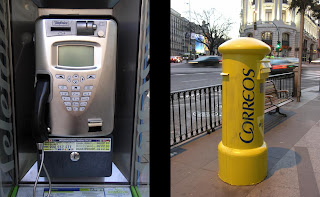 It goes something like this: "Huh, they have cool round mailboxes. Ours are square and blue, theirs are round and yellow. They are different. One is yellow, the other is blue." or "Our phones don't look like that. Ours are more square. Theirs are more round" etc. Not a whole lot of brilliant, high level thinking going on just after class.
Then I take a picture of the item, and people look at me funny. Now, I have amassed quite a number of these relatively-pointless photographs, and feel I must do something productive with them. So, let me take a moment to enlighten you on a few differences that you probably never really cared to know:


There are A LOT of Smart Cars here. I love looking for the Smart Cars. I know there are presently a limited number of Smart Cars in North America, but here in Madrid they are quite popular here. I think the picture at right does a pretty good job of illustrating why! (I wonder if this is even legal?)
I know these cars are sort-of 'death-traps' but the environmentalist in me loves how popular they are here.
 For those of you that are also reading Joanie Calder's South Korea blog, you'll surely remember when she showed a photo of a Korean building under construction that was covered by a lovely tarp to disguise the work-in-progress. Guess what Joans...they do that here too. They even make their coverings faux-colonial. Nice touch! (Has anyone seen this done in the US?)
 And here's one more thing that's a little different, but pretty cool. In order to increase the number of pedestrian only zones, Madrid has this great system for allowing only residents of a given street access the street. There is a small post blocking the street, and only residents know the code to make the post lower down momentarily to allow them to pass through. They punch it into the key pad, and the little post lowers. Much less obtrusive than a big gate or a flimsy piece of wood blocking the way.
Okay, yeah...I know it's a odd thing to take note of, but I think it's kind of cool. (And perhaps it is also done in the US, but I haven't seen it yet.)
 It goes something like this: "Huh, they have cool round mailboxes. Ours are square and blue, theirs are round and yellow. They are different. One is yellow, the other is blue." or "Our phones don't look like that. Ours are more square. Theirs are more round" etc. Not a whole lot of brilliant, high level thinking going on just after class.
Then I take a picture of the item, and people look at me funny. Now, I have amassed quite a number of these relatively-pointless photographs, and feel I must do something productive with them. So, let me take a moment to enlighten you on a few differences that you probably never really cared to know:


There are A LOT of Smart Cars here. I love looking for the Smart Cars. I know there are presently a limited number of Smart Cars in North America, but here in Madrid they are quite popular here. I think the picture at right does a pretty good job of illustrating why! (I wonder if this is even legal?)
I know these cars are sort-of 'death-traps' but the environmentalist in me loves how popular they are here.
 For those of you that are also reading Joanie Calder's South Korea blog, you'll surely remember when she showed a photo of a Korean building under construction that was covered by a lovely tarp to disguise the work-in-progress. Guess what Joans...they do that here too. They even make their coverings faux-colonial. Nice touch! (Has anyone seen this done in the US?)
 And here's one more thing that's a little different, but pretty cool. In order to increase the number of pedestrian only zones, Madrid has this great system for allowing only residents of a given street access the street. There is a small post blocking the street, and only residents know the code to make the post lower down momentarily to allow them to pass through. They punch it into the key pad, and the little post lowers. Much less obtrusive than a big gate or a flimsy piece of wood blocking the way.
 Okay, yeah...I know it's a odd thing to take note of, but I think it's kind of cool. (And perhaps it is also done in the US, but I haven't seen it yet.)
Escorial & Palacio Real
This was my Shockingly Enormous Old Structures week. Let's call it S.E.O.S. for short, (as a 'shout out' of sorts to my previous co-workers in the acronym-ridden world refugee resettlement :)
I saw a 650ft x 500ft monastery, a 2000 room royal palace, and a city enclosed by giant medieval walls. Phew...I'm tired. I'll focus on the first two in this entry, then write separately about the third.
MONASTERIO DE SAN LORENZO DE ESCORIAL
 After class yesterday, I took a 1 hour bus ride out to the small town of San Lorenzo de Escorial to see the monstrously huge 16th century monastery. At right is the photograph I took as I rode over the monastery in a helicopter. Either that, or it's a picture that I found at www.velo-touren.ch and decided to use on my blog in order to show the immense size of this structure.
Honestly, it's kind of a gloomy building, more like a spiffed up prison than a house of worship. It was clearly intended to be a statement of power, and it's absolutely enormous. With over 100 miles of walkways and thousands of rooms, I got lost over and over again during my visit.

 My favorite part was most definitely the astoundingly beautiful library. You are not permitted to photograph inside the monastery, but someone apparently disregarded this rule because I found the photo at right on the web. While 'you had to be there' is certainly true in this case, the photo perhaps gives a glimpse at how spectacular the library is, with its beautifully painted ceiling, rich wood bookshelves full of priceless ancient texts, and oooooh....such fantastic globes!

But it wasn't the globes that got me. I don't mean to betray my geographic training, but I was utterly enthralled with the Illuminated Manuscripts. So beautiful! It's fascinating to me to imagine some monk centuries ago toiling for hours over each small detail, each decorative flower, each placement of gold leafing, each fanciful letter. From the first time I saw Illuminated Manuscripts in the British Museum in London (10 years ago), I was hooked. I could stare at them for hours. But unfortunately, this is DEFINITELY a 'you have to see it in person' experience. I have never been able to replicate the same degree of awe by looking at coffee table books with reproductions of the pieces. It's gotta be the real thing.
But, library aside, did I enjoy my visit to Escorial? Kind of no. Perhaps I've had my fill of big buildings full of art (for now), but I just couldn't get into it. I enjoyed the moments when I was able to get a sense of what monastic life might have been like centuries ago, but as far as the room after room of paintings and tapestries and other things hanging on walls... I just didn't have the attention span for it.
I did have a pretty bad headache, so that surely contributed. In the end, I spent just over one hour at Escorial, deciding to throw in the towel when visions of my bottle of Advil held more attraction than priceless, centuries old works of art.
PALACIO REAL
 On Monday of this week I visited Madrid's royal place, the 'Palacio Real.' The present king and queen don't currently reside there, but for centuries it was the home for Spainish royalty.
I was expecting a Spanish Versailles, and that is sort of how it felt to me: lots of rooms that don't really seem to serve a purpose other than to make the palace bigger. You have room 32 with three chairs against the wall and two clocks, followed by room 33 with a small sofa along one wall and a painting on the opposing wall, followed by room 34... etc, etc. Does anyone know if this is really how the royals lived in these palaces? Maybe, 'in the day', they were full of furniture and purpose, but now it's just one room after another.
However, the first five rooms of the Palacio Real are SO over-the-top ornate that I LOVED them. The rest of the rooms: ho-hum. But these first five rooms were crazy! There was not a wasted square inch of empty space, and yet it somehow worked. I don't know what happened for the rest of the rooms, but whoever designed these rooms was an insane, impassioned genius. Again, no photography was allowed so the best I can do is borrow pictures taken by others, then posted on the web.
 Next to the palace (still part of the complex) is a museum housing an extensive collection of medieval armor for both man and horse. Amazing stuff, but more about that in the Avila entry...
I saw a 650ft x 500ft monastery, a 2000 room royal palace, and a city enclosed by giant medieval walls. Phew...I'm tired. I'll focus on the first two in this entry, then write separately about the third.
MONASTERIO DE SAN LORENZO DE ESCORIAL
 After class yesterday, I took a 1 hour bus ride out to the small town of San Lorenzo de Escorial to see the monstrously huge 16th century monastery. At right is the photograph I took as I rode over the monastery in a helicopter. Either that, or it's a picture that I found at www.velo-touren.ch and decided to use on my blog in order to show the immense size of this structure.
Honestly, it's kind of a gloomy building, more like a spiffed up prison than a house of worship. It was clearly intended to be a statement of power, and it's absolutely enormous. With over 100 miles of walkways and thousands of rooms, I got lost over and over again during my visit.

 My favorite part was most definitely the astoundingly beautiful library. You are not permitted to photograph inside the monastery, but someone apparently disregarded this rule because I found the photo at right on the web. While 'you had to be there' is certainly true in this case, the photo perhaps gives a glimpse at how spectacular the library is, with its beautifully painted ceiling, rich wood bookshelves full of priceless ancient texts, and oooooh....such fantastic globes!
But it wasn't the globes that got me. I don't mean to betray my geographic training, but I was utterly enthralled with the Illuminated Manuscripts. So beautiful! It's fascinating to me to imagine some monk centuries ago toiling for hours over each small detail, each decorative flower, each placement of gold leafing, each fanciful letter. From the first time I saw Illuminated Manuscripts in the British Museum in London (10 years ago), I was hooked. I could stare at them for hours. But unfortunately, this is DEFINITELY a 'you have to see it in person' experience. I have never been able to replicate the same degree of awe by looking at coffee table books with reproductions of the pieces. It's gotta be the real thing.
But, library aside, did I enjoy my visit to Escorial? Kind of no. Perhaps I've had my fill of big buildings full of art (for now), but I just couldn't get into it. I enjoyed the moments when I was able to get a sense of what monastic life might have been like centuries ago, but as far as the room after room of paintings and tapestries and other things hanging on walls... I just didn't have the attention span for it.
I did have a pretty bad headache, so that surely contributed. In the end, I spent just over one hour at Escorial, deciding to throw in the towel when visions of my bottle of Advil held more attraction than priceless, centuries old works of art.
PALACIO REAL
 On Monday of this week I visited Madrid's royal place, the 'Palacio Real.' The present king and queen don't currently reside there, but for centuries it was the home for Spainish royalty.
 I was expecting a Spanish Versailles, and that is sort of how it felt to me: lots of rooms that don't really seem to serve a purpose other than to make the palace bigger. You have room 32 with three chairs against the wall and two clocks, followed by room 33 with a small sofa along one wall and a painting on the opposing wall, followed by room 34... etc, etc. Does anyone know if this is really how the royals lived in these palaces? Maybe, 'in the day', they were full of furniture and purpose, but now it's just one room after another.
However, the first five rooms of the Palacio Real are SO over-the-top ornate that I LOVED them. The rest of the rooms: ho-hum. But these first five rooms were crazy! There was not a wasted square inch of empty space, and yet it somehow worked. I don't know what happened for the rest of the rooms, but whoever designed these rooms was an insane, impassioned genius. Again, no photography was allowed so the best I can do is borrow pictures taken by others, then posted on the web.
 Next to the palace (still part of the complex) is a museum housing an extensive collection of medieval armor for both man and horse. Amazing stuff, but more about that in the Avila entry...
Tapas! Tapas! Tapas!
There's one particular Spanish tradition that I so wish America would adopt: TAPAS! Tapas are perfect someone with food-related-ADD like me: just a little bit of this, then a little bit of that, then a little bit of this, and so on and so on. Considering my fondness for these little Spanish wonders, I figured they deserved their own entry.
Tapas are as Spanish as bullfighting and flamenco. It's not just a type of food, it's a way of life here, and the Spanish even have a verb that means "going out for tapas." If you have never heard of 'tapas', in short, they are small portions of seafood, salads, meat-filled pastries, and other goodies, often served on top of a slice of baguette. They are like appetizers, except much much much better.
Spaniards don't just go to one bar and order a bunch of tapas. They eat one or two at bar X, then head over to bar Y for another one, then move onto bar Z for several more. The typical 'tapas run' involves four or five bars, and sampling a whole array of tasty tapas. So, in true Madrileno style, Welmoud, Tom, Alan and I went on a 'tapas run' last Friday night, hitting five tapas bars and sampling over a dozen of different dishes.
 Before getting to the plot (the food), let me introduce the characters: that's Alan (a retired union negotiator from England) at left, Welmoud (a geologist from Holland) in the middle, and Tom (an artist from Canada) at right. Tom had just bought a rose from a roaming salesperson, and had rigged it into the wall of the bar. (Can you tell from his pose that he is the artist of the group?)
We arrived at our first tapas bar at 7:30, and in true Spanish style, they were just opening for the night. Since we were "so early", we were only able to order drinks, since food wouldn't even be ready until after 8pm. So we drank a round (and yes, I stuck with my oh-so-classy Diet Coke), then headed to bar #2, which specialized in tapas from the Basque country. DELICIOUS--my favorite of the night! After four different tapas here, we headed to bar #3 at about 9pm, a standing room only bar that has absolutely delicious (if a bit pricy at $4 a pop) tapas. We had four different tapas here as well, then, at about 10pm, wandered into bar #4, which had been recommended to us by an elemadrid teacher.
 I was less impressed with the three tapas we had here--kind of bland--but that's the beauty of the system. Low commitment! At about 11:30pm, we hit bar #5 for two more tapas. We could hardly find a place to sit it was so crowded (and actually this was after giving up on several other tapas bars that were just way too packed). For bar #6, we returned to the bar that we started at, and had another round of drinks until 2am.
Sound late to be eating? Not for Madrid. At 2am, when we left our last bar for the night, the streets of Madrid's "La Latina" neighborhood were full. Madrilenos are nicknames 'gatos' (cats) for their incurable night prowling. By Madrid standards, we actually headed in early.
So how does one choose which tapas to eat?
At most of the tapas bars that I have been to, the tapas are displayed under glass at the bar, so you don't really have to know Spanish to order. You just see what looks good and point.
 But, if you don't have the option to preview your selection ahead of time...no matter. It's just a tapa. If you order badly, oh well. Just order something else. It's not like ordering an entire entree that you end up disliking. It's just a little tapa!
 Tortillas, Spanish style
Of the hundreds (or more?) different kind of tapas, perhaps the most traditional and popular one is the tortilla. However, the Spanish tortilla is NOTHING like the Mexican tortilla. In Spain, the tortilla is a dense and buttery potato omelet that somewhat resembles a less cheesy version of potatoes-au-gratin. I've had "Madrid's best tortillas" at the atmospheric, 100+ year old Cerveceria Alemana, and (at other non-disclosed locations) I've had some not-so-delicious versions, like the one pictured at right. But, in general, I give the Spanish tortilla two thumbs up.
A future full of FREE tapas...
I'm going to be in Granada for the month of May, and I've heard from several sources that most Granada tapas bars give a free plate of tapas with every drink you buy. Count me in! Of course, the going rate in restaurants for my drink of choice--Diet Coke--is about $2.50-$3.00 a can, so it's not the amazing savings it sounds like. But, it's better than paying for both.
As if I needed another reason to spend a month in Granada.
Tapas are as Spanish as bullfighting and flamenco. It's not just a type of food, it's a way of life here, and the Spanish even have a verb that means "going out for tapas." If you have never heard of 'tapas', in short, they are small portions of seafood, salads, meat-filled pastries, and other goodies, often served on top of a slice of baguette. They are like appetizers, except much much much better.
Spaniards don't just go to one bar and order a bunch of tapas. They eat one or two at bar X, then head over to bar Y for another one, then move onto bar Z for several more. The typical 'tapas run' involves four or five bars, and sampling a whole array of tasty tapas. So, in true Madrileno style, Welmoud, Tom, Alan and I went on a 'tapas run' last Friday night, hitting five tapas bars and sampling over a dozen of different dishes.
 Before getting to the plot (the food), let me introduce the characters: that's Alan (a retired union negotiator from England) at left, Welmoud (a geologist from Holland) in the middle, and Tom (an artist from Canada) at right. Tom had just bought a rose from a roaming salesperson, and had rigged it into the wall of the bar. (Can you tell from his pose that he is the artist of the group?)
We arrived at our first tapas bar at 7:30, and in true Spanish style, they were just opening for the night. Since we were "so early", we were only able to order drinks, since food wouldn't even be ready until after 8pm. So we drank a round (and yes, I stuck with my oh-so-classy Diet Coke), then headed to bar #2, which specialized in tapas from the Basque country. DELICIOUS--my favorite of the night! After four different tapas here, we headed to bar #3 at about 9pm, a standing room only bar that has absolutely delicious (if a bit pricy at $4 a pop) tapas. We had four different tapas here as well, then, at about 10pm, wandered into bar #4, which had been recommended to us by an elemadrid teacher.
 I was less impressed with the three tapas we had here--kind of bland--but that's the beauty of the system. Low commitment! At about 11:30pm, we hit bar #5 for two more tapas. We could hardly find a place to sit it was so crowded (and actually this was after giving up on several other tapas bars that were just way too packed). For bar #6, we returned to the bar that we started at, and had another round of drinks until 2am.
 Sound late to be eating? Not for Madrid. At 2am, when we left our last bar for the night, the streets of Madrid's "La Latina" neighborhood were full. Madrilenos are nicknames 'gatos' (cats) for their incurable night prowling. By Madrid standards, we actually headed in early.
So how does one choose which tapas to eat?
At most of the tapas bars that I have been to, the tapas are displayed under glass at the bar, so you don't really have to know Spanish to order. You just see what looks good and point.
 But, if you don't have the option to preview your selection ahead of time...no matter. It's just a tapa. If you order badly, oh well. Just order something else. It's not like ordering an entire entree that you end up disliking. It's just a little tapa!
  Tortillas, Spanish style
Of the hundreds (or more?) different kind of tapas, perhaps the most traditional and popular one is the tortilla. However, the Spanish tortilla is NOTHING like the Mexican tortilla. In Spain, the tortilla is a dense and buttery potato omelet that somewhat resembles a less cheesy version of potatoes-au-gratin. I've had "Madrid's best tortillas" at the atmospheric, 100+ year old Cerveceria Alemana, and (at other non-disclosed locations) I've had some not-so-delicious versions, like the one pictured at right. But, in general, I give the Spanish tortilla two thumbs up.
A future full of FREE tapas...
I'm going to be in Granada for the month of May, and I've heard from several sources that most Granada tapas bars give a free plate of tapas with every drink you buy. Count me in! Of course, the going rate in restaurants for my drink of choice--Diet Coke--is about $2.50-$3.00 a can, so it's not the amazing savings it sounds like. But, it's better than paying for both.
As if I needed another reason to spend a month in Granada.
Flamenco, Ole?… Flamenco, Oi Vay!
 |
How did it go? Well, the teacher didn’t exactly gush over my innate Flamenco ability, but then again I wasn’t any worse off than any of the other students. It wasn’t the moves that got me. Thanks to the years of dance lessons as a child, I have an adequate level of coordination. It was my brain, which had absolutely no interest in participating in the endeavor. This was me most of the night:
One, two, three. One, two, three. One…Do I need to do laundry tonight? No, I think I’m…Oh crap, where are we. Oh, okay…Clap, stomp, stomp. One, two, three. One, two, three…It’s too hot in here. Why doesn’t anyone else look hot? Is there a… Oh crap…
I could NOT get myself to concentrate. I wasn’t too hard on myself about it though. Really, my brain, which would not be chastised into cooperating, had a good point, which was “Who are you kidding? You don’t like dancing. I am not going to be a part of this.”
So, final judgement on the experience: I’ve danced Flamenco in Spain, but I don’t have a new hobby.
Madrid: An Art Lover’s Paradise
I couldn’t possibly spend an entire month in Madrid without writing at least one entry about the city’s fantastic museums. Madrid is a virtual treasure trove of spectacular works of art, and is absolutely packed with art venues. If you are not much into art, you can skip this entry.
I am going to briefly write about ‘the Big 3’ museums, but trust me, there are dozens more that deserve to be included! If you love art...you must come to Madrid!
THE PRADO
 I just got back from visiting the Museo del Prado, one of the world’s top museums, boasting an incredible collection of Spanish and European art, much of it originally collected by Spanish royalty. Many consider it to be the ‘best’ collection of art in the world.
Today was my first visit to the Prado. I plan to go again next week. Like the Louvre or the Met, you can’t “do” the Prado in one visit. For me, it would take MANY visits since two hours seems to be the limit of my art appreciation attention span. But I’m just going to go twice.
The Prado is best known for its extensive collection of works by three renowned Spanish artists: Velazquez, Goya and El Greco (who, in truth, was actually Greek—‘el greco’ means 'the Greek’ in Spanish—but he lived in Spain as an adult.) I focused today's visit primarily on these great artists, but was also able to check out many works by non-Spanish artists as well. Que fantastico!
At right is one of the Prado's BEST: Las Meninas by Velazquez, one of the greatest pieces of art of all time. (And Nancy, I gladly said 'hi' to them for you!):
THE REINA SOFIA
Just down the street from the Prado is Madrid’s museum of modern art—the Centro de Arte Reina Sofia. I visited the museum about a week ago with Welmoud, my Dutch friend from elemadrid. Unfortunately I wasn’t in an artsy mood, so I kind of just wandered through, not experiencing the thrill I felt at the other two museums. In fact, Welmoud and I probably spent as much time at the museum as we did chatting at the adjacent Starbucks during a mid-viewing break. :)
Like the Prado, the Reina Sofia has pieces from Europe and other regions, but works by Spanish artists dominate. In fact, almost half the museum is devoted to Pablo Piscaso, a Spaniard who fled to France when Franco took power. They have everything from his doodles on newspapers to world-renowned masterpieces, including Guernica (below). I was particularly taken by some of his busts. Brilliant!
 Along with Picasso, they also have many pieces by fellow Spanish artists Miro and Dali, (examples below), as well as numerous pieces by other artists. Despite my lackadaisical mood while at the Reina Sofia, I’d definitely say it’s a Must-Do when in Madrid.

THE THYSSEN
The Museo de Thyssen-Bornemisza’ was the first of the three museums that I visited, just two days after I arrived. Although it is often considered the least spectacular of the three, I had such a fantastic time here. It really gave me a shot of creativity about my future (which is another story, for later) and before I knew it, four hours had passed.
Many people feel this museum complements where the Prado is weak--like Impressionism--so if you love art or have two weeks or more in Madrid, I’d recommend going to the Thyssen as well as the other two. Here are a few pieces that stuck out for me:
 (Degas/Kandinsky/Lindner)
I am going to briefly write about ‘the Big 3’ museums, but trust me, there are dozens more that deserve to be included! If you love art...you must come to Madrid!
THE PRADO
 I just got back from visiting the Museo del Prado, one of the world’s top museums, boasting an incredible collection of Spanish and European art, much of it originally collected by Spanish royalty. Many consider it to be the ‘best’ collection of art in the world.
Today was my first visit to the Prado. I plan to go again next week. Like the Louvre or the Met, you can’t “do” the Prado in one visit. For me, it would take MANY visits since two hours seems to be the limit of my art appreciation attention span. But I’m just going to go twice.
The Prado is best known for its extensive collection of works by three renowned Spanish artists: Velazquez, Goya and El Greco (who, in truth, was actually Greek—‘el greco’ means 'the Greek’ in Spanish—but he lived in Spain as an adult.) I focused today's visit primarily on these great artists, but was also able to check out many works by non-Spanish artists as well. Que fantastico!
At right is one of the Prado's BEST: Las Meninas by Velazquez, one of the greatest pieces of art of all time. (And Nancy, I gladly said 'hi' to them for you!):
THE REINA SOFIA
Just down the street from the Prado is Madrid’s museum of modern art—the Centro de Arte Reina Sofia. I visited the museum about a week ago with Welmoud, my Dutch friend from elemadrid. Unfortunately I wasn’t in an artsy mood, so I kind of just wandered through, not experiencing the thrill I felt at the other two museums. In fact, Welmoud and I probably spent as much time at the museum as we did chatting at the adjacent Starbucks during a mid-viewing break. :)
Like the Prado, the Reina Sofia has pieces from Europe and other regions, but works by Spanish artists dominate. In fact, almost half the museum is devoted to Pablo Piscaso, a Spaniard who fled to France when Franco took power. They have everything from his doodles on newspapers to world-renowned masterpieces, including Guernica (below). I was particularly taken by some of his busts. Brilliant!
 Along with Picasso, they also have many pieces by fellow Spanish artists Miro and Dali, (examples below), as well as numerous pieces by other artists. Despite my lackadaisical mood while at the Reina Sofia, I’d definitely say it’s a Must-Do when in Madrid.
THE THYSSEN
The Museo de Thyssen-Bornemisza’ was the first of the three museums that I visited, just two days after I arrived. Although it is often considered the least spectacular of the three, I had such a fantastic time here. It really gave me a shot of creativity about my future (which is another story, for later) and before I knew it, four hours had passed.
Many people feel this museum complements where the Prado is weak--like Impressionism--so if you love art or have two weeks or more in Madrid, I’d recommend going to the Thyssen as well as the other two. Here are a few pieces that stuck out for me:
 (Degas/Kandinsky/Lindner)
Spectacular Segovia, part 3
 Our last stop on Betsy's virtual tour of Segovia: THE CASTLE!
  The most spectacular site in Segovia has to be its "Alcazar" (which is Spanish for 'castle', and was originally derived from the Arabic 'al-qasr'). What an evocative sight! The crenellated walls, Rapunzel towers, and an honest-to-goodness moat... it almost seems right out of Make-Believe-Land.
 Actually, according to my Lonely Planet guidebook, Walt Disney took its design for Sleeping Beauty's castle from this castle! (Of course, the guidebook then goes on to say, "... or so Segovia’s town propagandists would have you believe.")
Before touring the interior, we climbed to the top via a narrowing and winding staircase—quite a claustrophobic experience for me but surely nothing compared to how it must be in the hot, crowded summer, when the narrow passage has to accommodate those ascending AND those descending at the same time. (This is Spain’s low season so we only occasionally had to squeeze by other visitors going the other way.)


But…the view from the top was worth the strain on the lungs and the psyche. Que fantastico! The photo above is back toward the center of Segovia; the one at right is of the countryside behind the castle; and the photos below are of the castle's courtyard.
(Locate the church in the middle right of the picture to the right: That’s the Knight’s Templar church I mentioned yesterday.)
 The interior was in that typically royal style of 'if a little is good, more is better.' Obnoxiously overdone, but curiously beautiful at the same time.
  And, although my photographs certainly do not do them justice, I particularly liked the stained glass windows that lined the walls of the throne room and reception room. (Please click to enlarge, then use your imagination to picture them very large and very brightly lit from behind.)
 Most surprising of all, I LOVED all the armory, and while I could go on and on about that now, I am going to save it for another entry...
 So, that's it for Segovia. Hope you enjoyed your tour. :)
Spectacular Segovia, part 2
It's late Sunday night/Monday morning, and I can't sleep so I thought I'd get up and do something useful until my body is willing to cooperate. So...here's the next entry on Segovia. It's late so my writing will be grossly inadequate for the subject, but I know you'll forgive me. :)
The HISTORIC TOWN CENTER
In truth, what captured my attention most about Segovia wasn’t its imposing cathedral, its grand aqueduct, its evocative castle. It was the myriad designs embossed on the ordinary businesses and towns in Segovia’s historic town center. It’s unlike anything I have ever seen in all my travels. Simply stunning.
I took dozens of photographs, and included many below. To really see the designs, you'll need to click on the image to enlarge it:

 Pretty great, eh? Here are more examples—-small squares of other embossed designs on Segovia's homes and businesses. Amazing!!!
 Beyond the designs on buildings, the city really is very charming. I loved the layout of this plaza--the Plaza de San Martin:
 The center of old Segovia is the shady Plaza Mayor, lined by an eclectic assortment of buildings and cafes. My little camera doesn’t do groovy wide angle shots, so here’s my (poorly) stitched together three shots of the Plaza:
 Here’s an example of a typical street in the historic town center:
 And here’s one more image of Segovia to leave you with, until tomorrow:

UP NEXT: Photos of Segovia’s breathtaking castle.
The HISTORIC TOWN CENTER
In truth, what captured my attention most about Segovia wasn’t its imposing cathedral, its grand aqueduct, its evocative castle. It was the myriad designs embossed on the ordinary businesses and towns in Segovia’s historic town center. It’s unlike anything I have ever seen in all my travels. Simply stunning.
I took dozens of photographs, and included many below. To really see the designs, you'll need to click on the image to enlarge it:

 Pretty great, eh? Here are more examples—-small squares of other embossed designs on Segovia's homes and businesses. Amazing!!!
 Beyond the designs on buildings, the city really is very charming. I loved the layout of this plaza--the Plaza de San Martin:
  The center of old Segovia is the shady Plaza Mayor, lined by an eclectic assortment of buildings and cafes. My little camera doesn’t do groovy wide angle shots, so here’s my (poorly) stitched together three shots of the Plaza:
 Here’s an example of a typical street in the historic town center:
 And here’s one more image of Segovia to leave you with, until tomorrow:
UP NEXT: Photos of Segovia’s breathtaking castle.
Spectacular Segovia, part 1
 I saw this yesterday. Me, in person. I took this photograph of Segovia's stunning Iglesia de San Miguel from the top of Segovia's fairy tale castle. Ah, Segovia! Nothing I could say would do the town justice, but I will attempt to share a bit of my experience anyway.
Yesterday, I went on a day trip out to Segovia, about an hour outside of Madrid by bus. Segovia is a gem of a town, loaded with monuments, an aqueduct, cathedrals, a castle... The city center and the aqueduct were recently named Unesco World Heritage Sites, and I can't imagine it wasn't a unanimous decision!
 I went on a guided tour conducted entirely in Spanish for students like me. The guide, Sonia, was fascinating, and I was able to understand most of what she said. I sat by her on the bus and was even able to carry on a decent conversation. So fun! I could have just gone to Segovia alone, but I learned so much more by going with Sonia and the four other students (from a different school).
 I have dozens of photographs to share, so I am going to write about Segovia over the next three days. I'll start with the aqueduct and the cathedrals.
the AQUEDUCT
Our first stop was the aqueduct, Segovia's most recognizable symbol. I’m feeling lazy, so, uh, here’s what my guidebook has to say about it:
 “[The aqueduct] is an extraordinary feat of engineering, made even more remarkable by the fact that it was first raised here by the Romans in the 1st century AD. The 728m granite block bridge you see today is made up of 163 arches and, remarkably, not a drop of mortar was used to hold the whole thing together. The aqueduct was part of a complex system of aqueducts and underground canals which once brought water from the mountains 9 miles away to where the castle now stands.” (Lonely Planet)
The guide took us around a hidden corner to a spot where we could see the actual width of the top portion that carries the water.
It was surprisingly narrow, and quite a reminder that large projects built by the Romans were often massively more grandiose they needed to be. After all, who’d be impressed with a trench dug into the ground?
the CATHEDRAL
At the heart of the city is the beautiful 'Iglesia de San Miguel', embellished to the hilt with pinnacles and flying buttresses. I absolutely love this cathedral. When I first saw it, I think I took 20 photos of the exact same shot because I just didn't know what to do with myself.
 This Gothic cathedral was built in the "Flamboyant Gothic" style (the overripe, final stages of Gothic) and took over 200 years to complete. Once completed, it was the scene of Isabel's coronation as Queen of Castile.
The architecture and artwork on the interior was quite impressive, and the guide provided fascinating details about its creation, but sorry…photography was not allowed inside so I have no photos to share.
One of my favorite parts, however, was the cloistered garden—so peaceful and majestic—and I was able to photograph that part:
 There are many, many other cathedrals and monasteries in Segovia (as with virtually any other Spanish town!) but none as spectacular as the Iglesia de San Miguel. Most of the other churches are Romanesque in style, and are much less grandiose but still quite striking. I especially liked the many figured capitals on one of the churches. Here are just four of the 12 or so different capitals:
  Segovia even has a church built by the Knights Templar! Called “La Iglesia de la Vera Cruz”, it long housed what was claimed to be a piece of the True Cross ('vera cruz'), and the knights stood vigil over the holy relic 24 hours a day. Unfortunately I couldn't visit this church due to time constraints, but I saw it from afar. I got closer than I've ever been before. (See, my medieval goblet is half full.)
TOMORROW...
I'm going to sign off for now, but tomorrow I will share a bit about Segovia's historic city center, and on Tuesday I will write about the piece de resistance--Segovia's spectacular castle!
Subscribe to:
Comments (Atom)
-
I'm currently revising this blog, trying to get everything in one place. That means everything will be a mess for awhile.
-
 THE 'INTERESTING' STUFF I ate a few interesting things while on the camino. Octopus (“pulpa”) is real delicacy in the Galicia regi...